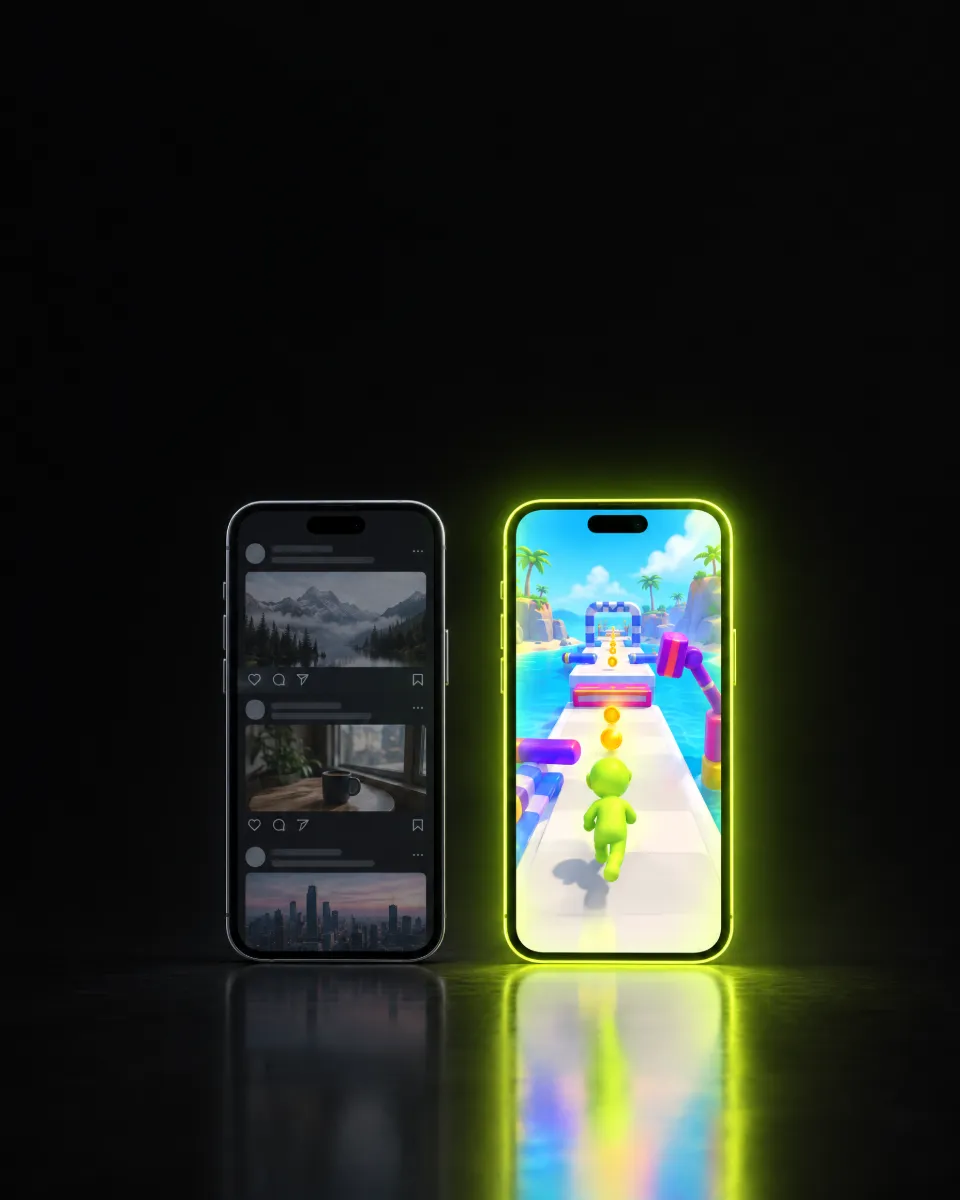
AppLovin vs TikTok ads comes down to one question: how old is your customer? AppLovin's ecommerce buyers skew heavily toward people aged 45 and older, while TikTok's heaviest users are adults under 30. Both run short vertical video on phones, but they reach different people in very different moments.
If your buyers are mostly 45+, AppLovin is usually the better next channel. If they are mostly under 35, TikTok is. If you sell to everyone, you can run both, but test them one at a time. The rest of this guide compares the two on inventory, audience, creative, attribution and budget.
Where the ads run
AppLovin places ads inside mobile apps, mostly games. The formats that matter for ecommerce are full-screen video. AppLovin's video guidance notes that interstitials give 5+ seconds of guaranteed attention, and rewarded placements, where a player watches an ad in exchange for an in-game reward, are skip-delayed for up to 60 seconds. Axon, AppLovin's AI engine, decides which ad to show to which person. AppLovin says it reaches over a billion daily active users worldwide, and Modern Retail reported that AppLovin cited about 150 million US daily active users in October 2025.
TikTok places ads in the feed, between organic videos. Users can scroll past at any moment, so the first second decides everything. TikTok also offers Spark Ads, which let a brand promote organic posts from its own account or, with permission, a creator's account, with engagement credited to the original post.
The practical difference: AppLovin buys attention that is briefly held. TikTok buys attention that has to be earned in real time, inside an entertainment feed.
Audience: who you actually reach
This is the biggest difference between the two platforms.
On AppLovin, the best public data comes from KnoCommerce, which runs post-purchase surveys for about 5,000 brands. Of the roughly 5,500 customers who said they bought after seeing a mobile game ad, over 96% were aged 45 or older. That is 2024 survey data, but no public dataset since has contradicted the skew.
On TikTok, Pew Research Center's 2025 survey found that 37% of US adults use TikTok, up from 21% in 2021, and 24% use it daily. Daily use is concentrated among the young: roughly half of 18 to 29 year olds go on TikTok at least once a day, compared with just 5% of adults aged 65 and older. Pew also found women stand out in their use of TikTok.
So the two channels are close to mirror images. TikTok is strongest where AppLovin is weakest, and the reverse. For many brands, that makes the choice easy once you look at your own customer age data.
Creative: what works on each
Both platforms want 9x16 vertical video. The style that wins is different.
AppLovin creative
AppLovin's own analysis of top-spending videos is unusually specific:
- 95% had prominent captions and 85% used voiceover.
- About 40% featured a promotion, and about 30% explicitly named who the product is for.
- 24% included social validation, and about 15% used provocative UGC-style hooks.
- AppLovin recommends testing all lengths, with a focus on videos longer than 30 seconds, and uploading as many portrait videos as possible, regularly.
In practice, that means clear, direct-response video: state the problem, show the product, give the offer. With an older audience and a full-screen format, captions and voiceover carry the message. More in our AppLovin creative best practices guide.
TikTok creative
In our experience, TikTok rewards content that looks like it belongs in the feed. Creator-led video, native editing and fast hooks tend to beat polished brand ads, and Spark Ads exist precisely so brands can run organic and creator posts as ads. Because viewers can swipe away instantly, the opening seconds carry more weight than on an interstitial.
A lot of TikTok creative can be adapted for AppLovin, but usually needs captions added, a clearer offer and a longer cut. Going the other way, AppLovin ads often feel too much like ads for TikTok.
Attribution and measurement
Both platforms count view-through conversions in some form, but they define and default them differently, which makes their dashboards hard to compare directly.
AppLovin reports two main windows for web campaigns, according to its measurement documentation: D0, purchases within 24 hours of the attributed engagement, and D7, purchases within 192 hours of a click. You can report on clicks only, or on clicks and views, which adds conversions within one day of an ad view.
TikTok lets advertisers choose attribution windows of 1 or 7 days for click-through, 1 or 7 days for engaged view-through, and off or 1 day for view-through. TikTok defines an engaged view as watching at least 6 seconds of the ad, or the full ad if it is shorter than 6 seconds.
Because the rules differ, do not pick a winner by comparing platform ROAS. Compare both against the same yardstick: new customer CPA from Shopify, a post-purchase survey with both "TikTok" and "mobile game or app ad" as answer options, and ideally a geo holdout test. Our guide to AppLovin attribution and incrementality walks through the setup.
Budgets and minimums
TikTok's floor is low. According to TikTok's help center, daily budgets must exceed $50 at the campaign level and $20 at the ad group level. That makes it easy to start small, though a test that low will learn slowly.
AppLovin is now open to any business through self-serve AppLovin Ads, which launched on June 22, 2026, with ROAS, cost per purchaser and lead generation buying models. In our experience it needs more budget to learn. We recommend starting at $500 a day. For context, Haus incrementality tests ran at an average of about $4,800 a day of AppLovin spend. See AppLovin ads cost and minimum budget for the full breakdown.
If you use an agency, pricing models vary. Apt publishes its pricing: $750 a month per channel plus 2.5% of ad spend, with the spend fee capped at $25,000 a month.
AppLovin vs TikTok ads at a glance
| Factor | AppLovin | TikTok |
|---|---|---|
| Where ads run | Inside mobile apps, mostly games; interstitial and rewarded video | In the feed between organic videos; Spark Ads from organic posts |
| Audience signal | Over 96% of mobile game ad buyers aged 45+ (KnoCommerce) | About half of US adults 18 to 29 use it daily, vs 5% of 65+ (Pew) |
| Attention | 5+ seconds guaranteed on interstitials; rewarded skip-delayed up to 60 seconds | Swipeable at any moment; engaged view counted at 6 seconds |
| Winning creative | Captioned, voiceover, direct offer, often 30+ seconds | Native, creator-led, fast hooks |
| Attribution windows | D0 and D7; clicks only or clicks plus 1-day views | Click 1 or 7 days; engaged view 1 or 7 days; view off or 1 day |
| Minimum budget | We recommend starting at $500 a day | Over $50 a day per campaign, over $20 per ad group |
| Best for | DTC brands with older customers and a clear offer | Brands with younger customers and creator-friendly products |
AppLovin or TikTok for ecommerce: when to use which
Use your own customer data first: survey answers, age data from Meta or GA4, and who actually buys. Then apply these rules of thumb.
- Choose AppLovin first if most of your buyers are 45+, you sell mainly direct to consumer, and you can produce a steady flow of captioned, offer-led video. Health, wellness, supplements, skincare and comfort products often fit here.
- Choose TikTok first if most of your buyers are under 35, your product looks good in creator content, and you want to start with a small budget.
- Run both if you sell across ages and already have Meta working. Launch one, get it stable, then add the other, so you can see what each one adds.
- Wait on both if your tracking is not set up or you cannot fund a few weeks of testing. Fix Meta and your site first.
For many brands the real alternative to AppLovin is Meta, not TikTok. If that is your decision, read AppLovin vs Meta ads next. And for an honest look at the independent AppLovin data, see does AppLovin work for ecommerce.
FAQ
Is AppLovin better than TikTok ads?
It depends on your customer. AppLovin tends to work better for brands whose buyers are 45 and older, since over 96% of mobile game ad buyers in KnoCommerce survey data were in that age group. TikTok tends to fit brands selling to adults under 35.
Who uses TikTok the most?
Younger adults. Pew Research Center found that roughly half of US adults aged 18 to 29 use TikTok at least once a day, compared with 5% of adults aged 65 and older. Overall, 37% of US adults use TikTok.
What age group does AppLovin reach?
Mostly older shoppers. KnoCommerce found that over 96% of the roughly 5,500 customers who attributed a purchase to a mobile game ad were aged 45 or older.
Can I use my TikTok ads on AppLovin?
Often, yes, with changes. AppLovin's data shows 95% of top-spending videos had prominent captions and 85% used voiceover, and it recommends testing videos longer than 30 seconds, so most TikTok cuts need captions, a clearer offer and a longer version.
What is the minimum budget for TikTok ads vs AppLovin?
TikTok requires daily budgets above $50 per campaign and above $20 per ad group. AppLovin needs more to learn; we recommend starting at $500 a day.
Should I run AppLovin and TikTok at the same time?
You can, but launch them one at a time. Get one channel stable, then add the other, so you can measure what each adds against your Shopify new customer numbers and post-purchase surveys.
AppLovin, TikTok or both?
Book a free call and we will look at your customer data and tell you which channel to test next and how much to put behind it.
Book a free call →Sources
Facts in this article were checked against these sources on September 28, 2026.
- KnoCommerce: Is AppLovin worth the hype?
- AppLovin: AppLovin Ads is now open
- Modern Retail: AppLovin rebrands its ad platform as Axon
- AppLovin Support: Video best practices
- AppLovin Support: Measurement and attribution (web)
- Haus: Is AppLovin more than a hype channel?
- Pew Research Center: Americans' Social Media Use 2025
- TikTok Business Help Center: Budget
- TikTok Business Help Center: Spark Ads
- TikTok Business Help Center: Attribution windows
- TikTok Business Help Center: Engaged view-through attribution