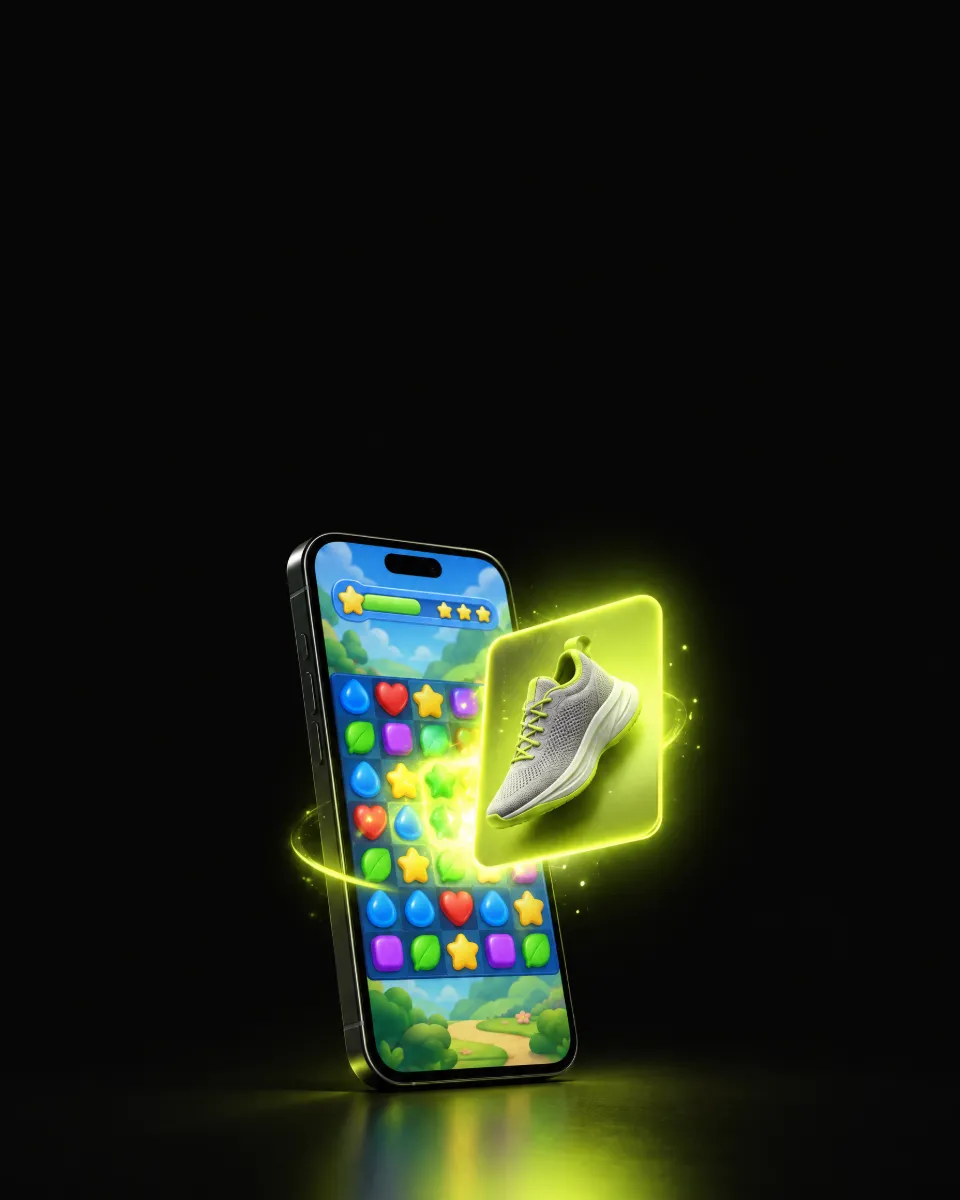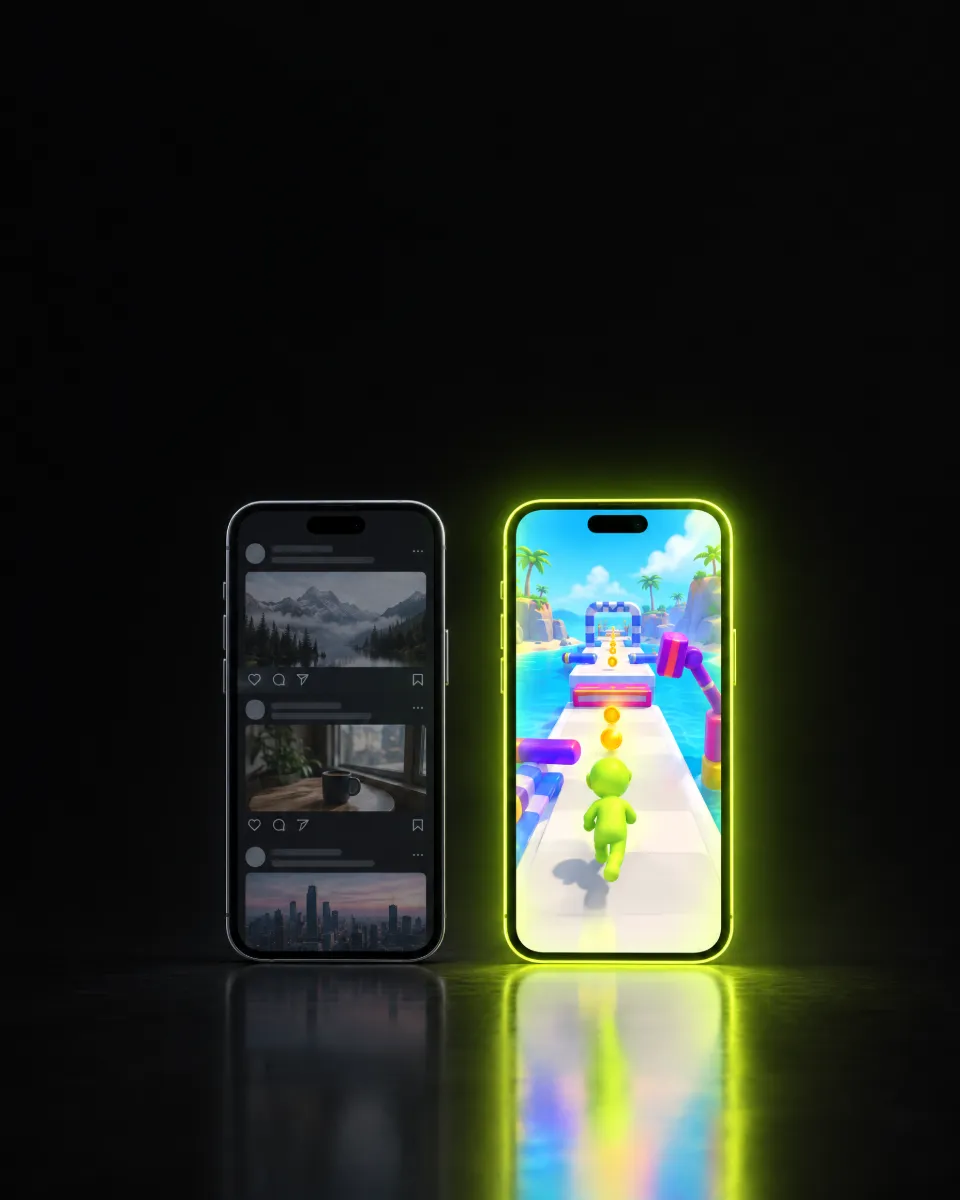
Most DTC brands we talk to spend the majority of their budget on Meta. So when AppLovin comes up, the question is usually framed as a fight: which one is better? That is the wrong framing. The two platforms reach people in completely different moments, give you very different controls, and reward different kinds of creative.
Here is an honest comparison, based on AppLovin's own documentation, Meta's developer updates, and what we see running both.
The short answer
Meta is still the most versatile paid channel for DTC: huge reach, mature tooling, many placements and formats. AppLovin is a narrower, more automated channel that puts one full-screen video in front of a relaxed, attentive viewer, and lets its AI decide who sees it. For many brands the right move is not either or. It is Meta as the base, with AppLovin as a second channel that can carry real volume.
AppLovin vs Meta side by side
| AppLovin | Meta | |
|---|---|---|
| Where ads run | Inside mobile games, during breaks in play. Expansion to non-gaming apps, the open web and CTV is planned. | Facebook, Instagram, Messenger, Threads and the Audience Network, across feeds, Stories and Reels. |
| Format | One full-screen 9:16 video (up to 60 seconds), then an interactive page, then dynamic product ads. | Many: image, video, carousel, collection, in many aspect ratios. |
| Targeting | No interests or demographics. Choose Universal, Prospecting or Discovery, plus geography. | Broad or Advantage+ audiences, with optional interests, custom audiences and lookalikes. |
| Bidding | Automatic, billed on impressions. Goals: ROAS, cost per purchaser, or leads. | Several bid strategies, including cost caps and bid caps. |
| Attribution | Report on clicks only, or clicks plus one-day view. Day 0 or Day 7 optimization windows. | Click windows of 1, 7 or 28 days, plus 1-day view and 1-day engaged view. |
| Minimum budget | AppLovin lists $10 a day; we recommend $500 a day for a real test. | Low minimums, set per ad set. |
Inventory and attention
On Meta, your ad competes with friends, creators and news in a feed that someone is scrolling through quickly. On AppLovin, your ad takes over the whole screen during a pause in a game. AppLovin reports that its users play for over an hour a day and that median engagement with its ads is about 35 seconds.
That difference in attention changes what works. A hook still matters, but on AppLovin you often have time to tell a fuller story: the problem, the product, the proof and the offer. AppLovin's own data backs this up. In a creative study published in June 2026, the top 5 percent of videos on the platform averaged 37.4 seconds long.
Targeting and control
Meta has been moving toward automation for years with Advantage+, but it still lets you layer in interests, custom audiences and exclusions. AppLovin gives you almost none of that. You choose a goal, an audience strategy and a location, and Axon does the rest.
For a media buyer used to adjusting audiences daily, this can feel uncomfortable. In practice, it moves the work to places that matter more: feeding the algorithm accurate purchase data through the pixel and Conversion API, setting realistic targets, and producing enough creative for the model to learn from.
Creative
Creative is where most failed AppLovin tests go wrong, usually because a team runs its Meta playbook unchanged. Three differences stand out:
- Length. Short 9 to 15 second cuts are standard on Meta. On AppLovin, AppLovin recommends prioritizing videos of 30 seconds or longer.
- Volume. In AppLovin's June 2026 test, campaigns running all available creatives beat hand-picked "top winner" sets by 7 to 23 percent in every case. The all-creatives campaigns averaged 182 active creatives.
- Pausing. On Meta, killing losers fast is standard practice. AppLovin advises against manually pausing creatives, because an ad that does not get the last click may still be one of the roughly eight ads a buyer sees before converting.
The good news: your best Meta videos are often the raw material for AppLovin. Recut to 9:16, extended with more demo and proof, and captioned (95 percent of AppLovin's top-spending videos use prominent captions), they can be a fast way to build volume.
Attribution
Comparing numbers across the two platforms is where teams get misled. AppLovin lets you report on clicks only, or on clicks plus purchases within one day of a view. It optimizes to a Day 0 window (purchases within 24 hours of engagement) or a Day 7 window. AppLovin notes that the reporting setting changes how results are shown, not how ads are optimized or billed.
Meta also narrowed its reporting windows this year. Since January 2026, Meta's Ads Insights API no longer returns 7-day view or 28-day view data, leaving 1, 7 and 28-day click plus 1-day view and 1-day engaged view.
The practical takeaway: do not judge a new channel on platform-reported ROAS alone. Watch blended new-customer revenue against total spend, and watch branded search and direct traffic when AppLovin turns on. Upper-funnel channels almost always look worse on last click than they really are.
What the independent data shows
The strongest outside evidence so far comes from Triple Whale, which analyzed 12 months of data from 755 ecommerce brands spending on AppLovin. Using its multi-touch attribution, lifetime ROAS on AppLovin was 2.90, against 2.08 on the other ad platforms those brands ran, most of them social channels like Meta. That is roughly 39 percent more revenue per ad dollar, and 61 percent of the brands saw a higher ROAS on AppLovin than on their other channels.
Attribution can flatter any channel, so the incrementality tests matter more. In seven independent geo holdout tests, five were statistically significant, and all five showed a positive revenue lift, averaging 8.3 percent and ranging from 3.5 to 13.5 percent. In other words, AppLovin was driving sales that would not have happened otherwise.
When to add AppLovin next to Meta
AppLovin tends to be worth a serious test when:
- Meta is working but getting more expensive to scale, and you need a second channel that can take real budget.
- You have a product that demos well in a 30 to 60 second video.
- You can produce or recut creative at volume, every week.
- Your tracking is clean and you can give a test three to four weeks.
It is probably not the right next step if your Meta account is still unprofitable, your margins cannot absorb a learning period, or you only have a handful of ads. Fix those first.
Ready to test? Our AppLovin launch checklist walks through setup, tracking, targets and creative. New to the platform? Start with what AppLovin advertising is.
Want AppLovin run for you?
Apt is an official AppLovin Partner Agency. We handle tracking, targets and the creative volume the platform rewards, alongside your Meta, Google and TikTok.
Book a free call →Sources
Facts in this article were checked against these sources on September 28, 2026.
- AppLovin: Campaign Management API (targeting and goals)
- AppLovin: Consumer brands (engagement, minimum budget)
- AppLovin: Ad specs and requirements
- AppLovin: June 2026 ecommerce update (creative volume test)
- AppLovin: Video best practices
- AppLovin: Designing creatives (Feb 20, 2026)
- AppLovin: Measurement and attribution
- Triple Whale: Does AppLovin Actually Drive Revenue? (Sep 3, 2026)
- Meta for Developers: Ads Insights API metric availability updates (Oct 16, 2025)
- AdExchanger: AppLovin asks for patience as it grows its ecommerce business (Aug 6, 2026)